Advanced Analytics
Overview
Cloudflare logs data is ingested, stored, and intelligently aggregated by ObserveNow using ClickHouse as the high-performance storage and query engine. This comprehensive analytics solution automatically processes raw Cloudflare log events into multiple aggregation layers, enabling advanced analytics, real-time monitoring, and historical trend analysis. This document provides a guide on querying the Cloudflare analytics tables using Grafana.
Jump to the Common Query Patterns section for example queries.
Querying Using Grafana
The Cloudflare logs data is accessible in Grafana through the data source ClickHouse Logs.
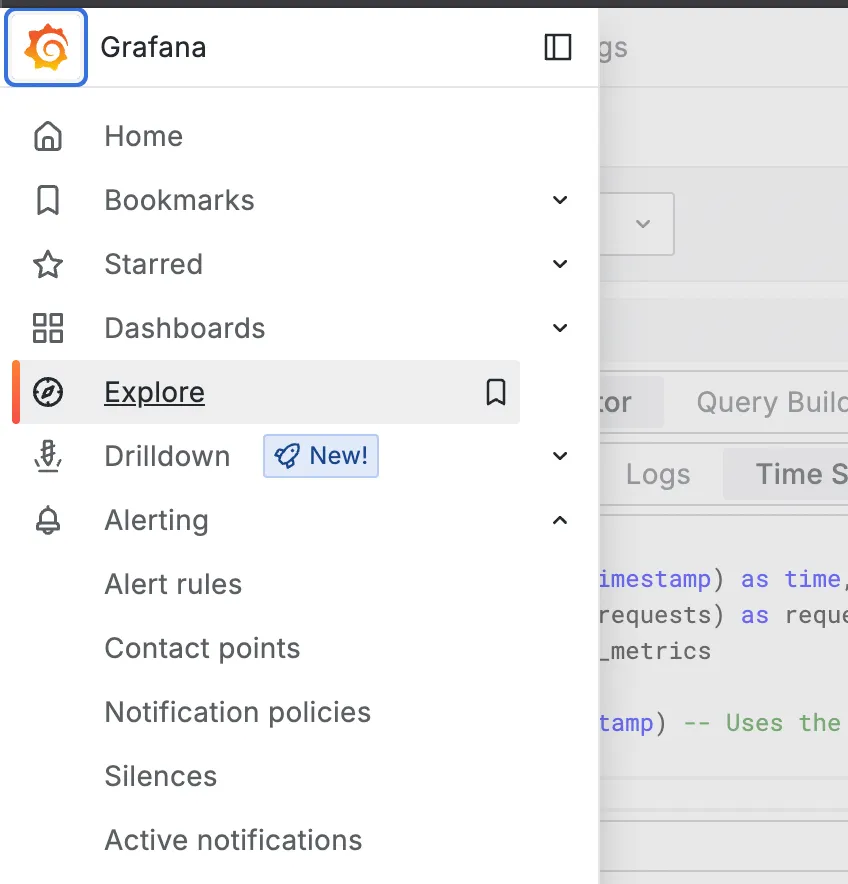
In your Grafana, navigate to the Explore section:
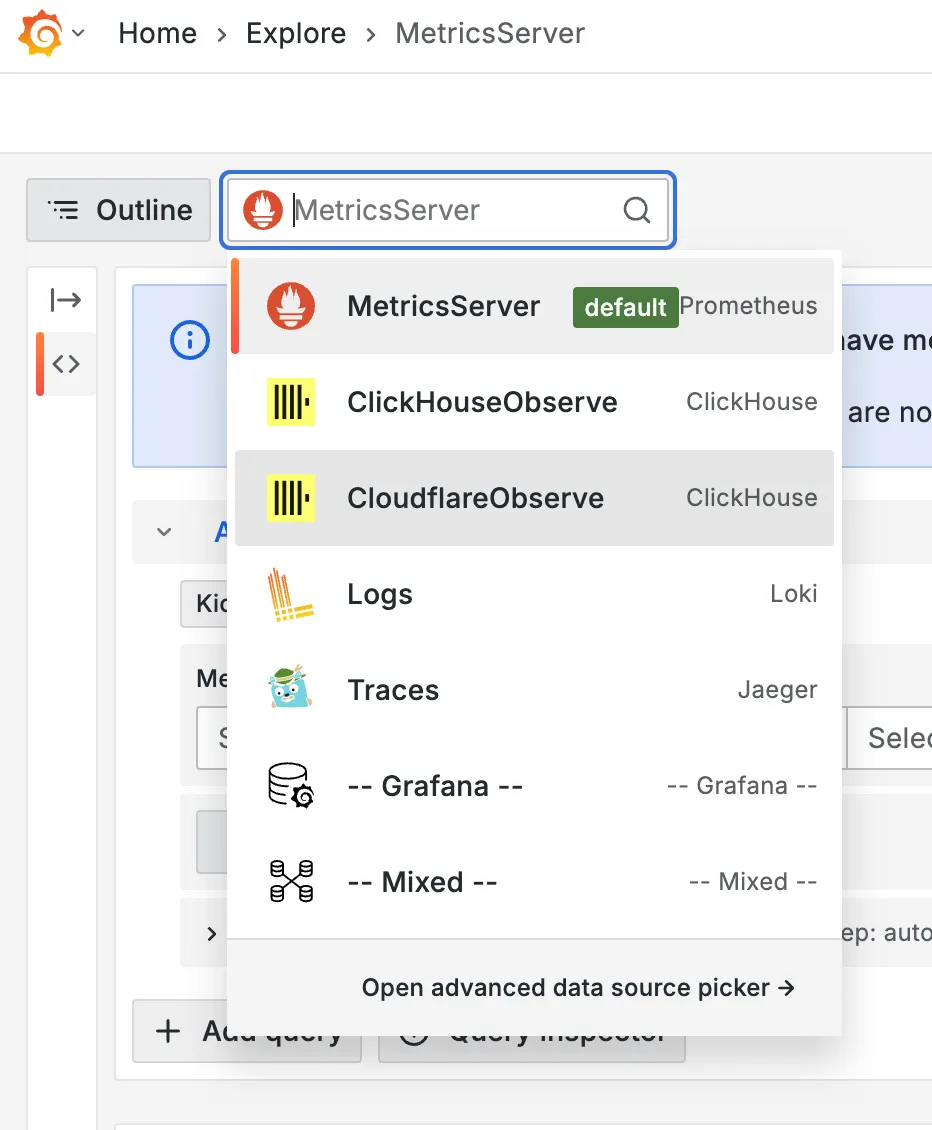
Select CloudflareObserve as the datasource:
Use either the Query Buiilder or the SQL Editor views and enter your query. Select the Table or Time Series option based on how you want to view the results:
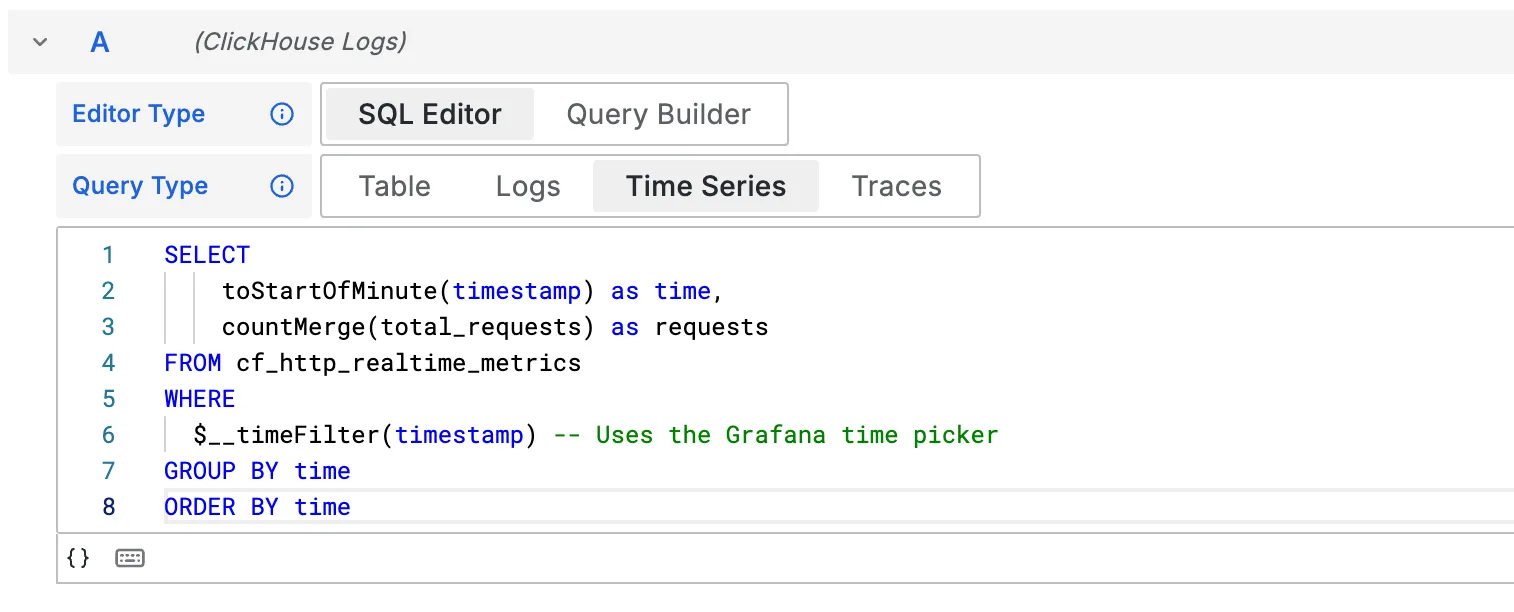
Table Architecture
ObserveNow uses a multi-tier approach with one raw table and several pre-aggregated tables for optimal query performance:
- Raw Data: events - Full detailed logs
- Aggregated Metrics:
- cf_http_aggregated_metrics (1 min aggregations)
- cf_http_aggregated_hourly
Table Details
1. Raw Data Table
- Table: events
- Purpose: Stores complete Cloudflare logs with full details for deep analysis and debugging.
- Best For: Detailed investigation, debugging specific requests, custom analytics
Events Table Schema
Table: events
timestamp - Event timestamp with nanosecond precision
service_name - Name of the service generating the event
id - Unique event identifier
TenantID - Tenant identifier
ClientRequestPath - Client request path
RayID - RayID
ZoneName - Zone name
ClientRequestHost - Client request host
EdgeResponseStatus - HTTP response status code
ResponseTimeMs - Response time in milliseconds
attributes_json - JSON attributes stored as key-value map
indexed_attributes - Indexed attributes for faster querying
2. Aggregated Table
- Table: cf_http_aggregated_metrics
- Purpose: Near real-time monitoring and alerting with 1-minute granularity.
- Best For: Real-time dashboards, alerting, performance monitoring
Dimension Columns (Grouping Keys)
Column Name | Description |
|---|---|
timestamp | Time bucket for metric aggregation |
ZoneName | Cloudflare zone/domain name |
ClientRequestHost | Host header from client request |
TenantId | Tenant identifier for multi-tenant applications |
NormalizedPath | Normalized URL path (e.g., /api/users/*) |
CacheCacheStatus | Cache status (HIT, MISS, EXPIRED, BYPASS) |
ResponseStatus | HTTP response status code group |
ClientRequestSource | Source of the client request |
EdgeColoCode | Cloudflare edge datacenter code |
ClientCountry | Client country code |
Aggregate Function Columns (Metrics)
Core Request Metrics
Column Name | Description |
|---|---|
TotalRequests | Total number of requests |
RequestsPerMinute | Average requests per minute |
TotalBytesServed | Total bytes served to clients |
Performance Metrics
Column Name | Description |
|---|---|
AvgClientDurationMs | Average client request duration in milliseconds |
P90ClientDurationMs | 90th percentile client request duration |
P95ClientDurationMs | 95th percentile client request duration |
P99ClientDurationMs | 99th percentile client request duration |
HTTP Status Code Metrics
Column Name | Description |
|---|---|
SuccessRequests | Count of successful requests (2xx status codes) |
Error4xxRequests | Count of client error requests (4xx status codes) |
Error5xxRequests | Count of server error requests (5xx status codes) |
Cache Performance Metrics
Column Name | Description |
|---|---|
CacheHits | Count of cache hit requests |
CacheMisses | Count of cache miss requests |
CacheExpired | Count of expired cache requests |
CacheBypass | Count of cache bypass requests |
Security & WAF Metrics
Column Name | Description |
|---|---|
WAFHighAttackRequests | Count of requests with high WAF attack scores |
WAFHighRCERequests | Count of requests with high RCE attack scores |
WAFHighSQLiRequests | Count of requests with high SQL injection scores |
WAFHighXSSRequests | Count of requests with high XSS attack scores |
AvgWAFAttackScore | Average overall WAF attack score |
AvgWAFRCEAttackScore | Average RCE (Remote Code Execution) attack score |
AvgWAFSQLiAttackScore | Average SQL injection attack score |
AvgWAFXSSAttackScore | Average XSS (Cross-Site Scripting) attack score |
Bot Detection Metrics
Column Name | Description |
|---|---|
VerifiedBotRequests | Count of requests from verified bots |
Compression & Size Metrics
Column Name | Description |
|---|---|
AvgCompressionRatio | Average response compression ratio |
AvgRequestBytes | Average request size in bytes |
AvgResponseBytes | Average response size in bytes |
Common Query Patterns
Real-Time Monitoring
Request Rate
Error Rate Percentage
Performance Analysis
Response Time Percentiles
Cache Hit Rate
Traffic Analysis
Top Requested Paths
Use the Table option to view the results of queries without a time field.
Traffic by Country
Use the Table option to view the results of queries without a time field.
Security Monitoring
WAF Attack Trends
Multi-Tenant Analysis
Per-Tenant Request Volume
Grafana Dashboarding Tips
Variable Setup
Create dashboard variables for dynamic filtering:
- $tenant_id - Tenant selection
- $zone_name - Zone/domain selection
- $time_range - Time range picker
Panel Queries
Use these patterns in your Grafana panels:
Time Series Panel (Request Rate)
Stat Panel (Cache Hit Rate)
Performance Optimization
- Choose the Right Table: Use the most aggregated table that meets your time granularity needs
- Filter Early: Always include time filters and tenant/zone filters when possible
- Use Indexes: The tables are optimized for queries filtered by timestamp, zone_name, host, and tenantid
- Limit Results: Use LIMIT clauses for top-N queries
Common Grafana Functions
- $__timeFilter(timestamp) - Automatic time range filtering
- $__timeInterval(timestamp) - Dynamic time grouping based on dashboard time range
- The clickhouse functions sumMerge(), avgMerge(), quantileMerge() are required for querying from aggregated columns
Best Practices
- Start with Aggregated Tables: Use the most appropriate aggregation level for your use case
- Use Raw Data Sparingly: Only query clickhouse_logs for detailed investigation or when aggregated data isn't sufficient
- Filter by Time/Tenant/Host: Always include tenant filtering for multi-tenant environments